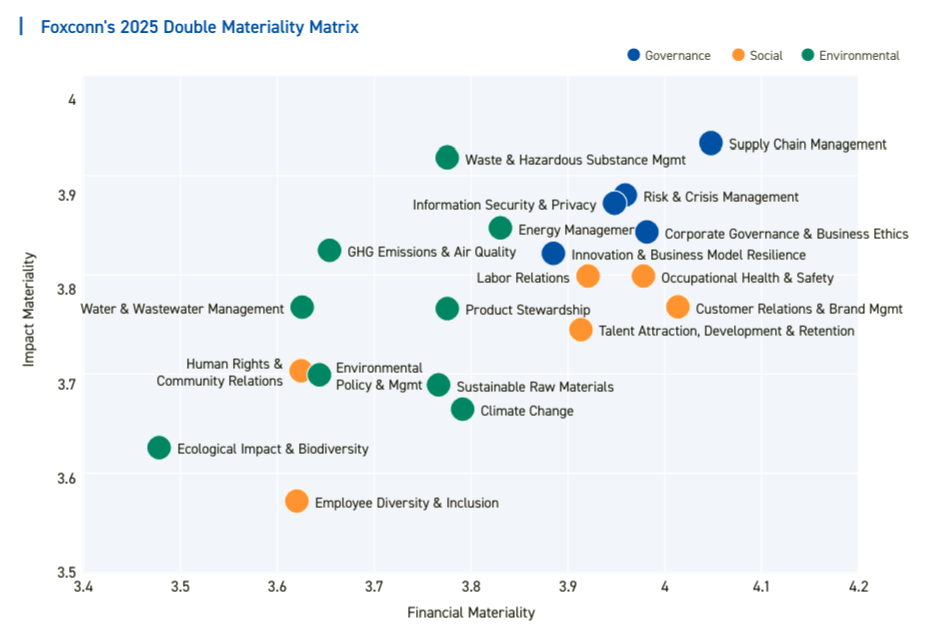
In identifying sustainability issues, Hon Hai benchmarked its performance against international standards to ensure comprehensiveness in its selection of material issues. These standards include the Global Reporting Initiative (GRI) and the Sustainability Accounting Standards Board (SASB). Hon Hai also referenced the sustainability practices of leading peers in the electronics manufacturing services (EMS) and original design manufacturing (ODM) industries to determine the scope of relevant issues. By evaluating issues across environmental, social, and governance dimensions, combined with considerations of the Group's internal management and business strategies, the Group ultimately identified 20 material issues for further stakeholder research.
1.2 Identification of key stakeholder groups
To ensure that Hon Hai's materiality analysis reflects the concerns of the Group's various stakeholders, we first identified relevant internal and external stakeholders. Key internal stakeholders include the Group's Board of Directors, employees, and senior management (first- and second-tier management). External stakeholder groups include customers, investors, and suppliers. We also included government agencies, media and public relations, non-governmental organizations (NGOs), community groups, public associations, research institutions, and other relevant internal and external stakeholder groups.
2: Analyze the impact of major issues
2.1 Survey stakeholders to assess the impact of selected issues
Hon Hai conducted a stakeholder survey and assessed the impact of sustainability issues from the perspectives of financial materiality and impact materiality. Survey respondents were asked to rate the financial impact of each issue on Hon Hai on a scale of 1-5, where 1 represents the lowest impact and 5 represents the highest impact. In addition, respondents were asked to assess the environmental, social, and economic impacts of material issues using the same criteria. Impact was determined based on a combination of the magnitude and likelihood of an event. To gain a deeper understanding of each stakeholder group's perspective on the positive and negative impacts of the 20 selected material issues, Hon Hai also asked participants to select up to three of the most significant positive , based on both financial impact and environmental, social, and economic impacts. The Group distributed questionnaires to the identified internal and external stakeholder groups and received a total of 347 responses.
2.2 Analyze the survey results
The Group's Sustainability Team and external consultants assessed the relative importance of material issues based on the feedback collected. First, we calculated the average score of each stakeholder group for each issue to reduce bias caused by uneven sample sizes. Next, we averaged the scores of each stakeholder group to obtain average scores on the financial materiality and impact materiality dimensions, ultimately producing a materiality matrix covering all material issues. The calculated results show that scores on the materiality matrix ranged from 3 to 4.5, with a high of 4.15 and a low of 3.17. The analysis shows that social and governance issues, such as customer satisfaction, business ethics, and sustainable supply chains, ranked high in both financial and impact materiality. Energy management emerged as the foremost environmental issue.